Saturday, September 12, 2026

The Eight Queens Problem : Explanation

Learn With Champak

Eight Queens Problem Using Backtracking

The Eight Queens problem is a classic combinatorial problem. The objective is to place eight queens on an 8 × 8 chessboard so that no two queens can attack each other.

Therefore, no two queens may share:

  • The same row
  • The same column
  • The same diagonal

How backtracking solves the problem

Backtracking builds a solution one row at a time. A queen is placed in a safe column, and the algorithm then advances to the next row. If no safe position is available, it returns to the previous row and tries another position.

If two queens occupy positions (row1, column1) and (row2, column2), they attack each other when:

column1 === column2

Math.abs(row1 - row2) === Math.abs(column1 - column2)

Select “Generate Solutions” to begin.

JavaScript backtracking algorithm

function solveQueens(row) {
  if (row === 8) {
    solutions.push([...positions]);
    return;
  }

  for (let column = 0; column < 8; column++) {
    if (isSafe(row, column)) {
      positions[row] = column;
      solveQueens(row + 1);
    }
  }
}

The Eight Queens problem has 92 solutions. The interactive demonstration above lets you inspect them individually or play them automatically.

Learn With Champak: This is an excellent example for understanding recursion, constraint checking and backtracking.

Saturday, June 16, 2012

Some sorting methods in C

Learn With Champak
BubbleSort

#include<stdio.h>
int main()
{
int i,j,t,a[]={3,9,7,1,4},n=5;
for(i=0;i<=(n-2);i++)
for(j=0;j<5-i-1;j++)
{ if(a[j]>a[j+1])
  {t=a[j];
   a[j]=a[j+1];
   a[j+1]=t;
  }
}
for(i=0;i<5;i++)
printf("%d,",a[i]);
return(0);
}


CountingSort

#include<stdio.h>
int main()
{
int i,t,a[]={8,7,4,1,0,5,9,2},b[]={0,0,0,0,0,0,0,0,0,0},j,k=0;
for(i=0;i<8;i++)
printf("%d,",a[i]);
printf("\n\n");
for(i=0;i<8;i++)
{ t=a[i];
  b[t]=b[t]+1;
}
for(i=0;i<10;i++)
printf("%d,",b[i]);
printf("\n\n");
for(i=0;i<10;i++)
{ if(b[i]==0)
  continue;
  t=b[i];
  for(j=0;j<t;j++)
  {a[k]=i;
   k++;
  }
}
for(i=0;i<8;i++)
printf("%d,",a[i]);
printf("\n\n");
/*Time complexity 3n*/
return(0);
}


HeapSort

#include<stdio.h>
int main()
{
int i,a[]={0,68,-7,45,6,57},n=6,t,k,l;
int b[n+1];
int left,right,pos,j,parent;

for(i=0;i<6;i++)
{
b[i+1]=a[i];
j=i+1;
while(1)
{
parent=j/2;
if(parent<1)
break;
if(b[parent]>=b[j])
break;
t=b[parent];
b[parent]=b[j];
b[j]=t;
j=parent;
}
}
for(i=1;i<7;i++)
printf("%d,",b[i]);
printf("\n\n");


for(i=1;i<=n;i++)
{
a[n-i]=b[1];
l=n-i+1;
b[1]=b[l];
l--;
j=1;
while(1)
{
left=2*j;
right=2*j+1;
if(left>l)
break;
if(right>l)
{
if(b[j]>b[left])
break;
t=b[j];
b[j]=b[left];
b[left]=t;
break;
}
if(b[left]>b[right])
pos=left;
else
pos=right;
if(b[j]>b[pos])
break;
t=b[pos];
b[pos]=b[j];
b[j]=t;
j=pos;
}
}

for(i=0;i<6;i++)
printf("%d,",a[i]);
printf("\n\n");

/*Time complexity nlog(base 2)n*/
/*For Quick and Merge too.*/
return(0);
}
InsertionSort

#include<stdio.h>
int main()
{

int i,j,t,a[]={5,9,3,0,1},n=5;
for(i=0;i<=n-2;i++)
{
  if(a[i]<=a[i+1])
  continue;
 
  j=i+1;
  t=a[j];
  while(j>=1 && a[j-1]>t)
  { a[j]=a[j-1];
    j--;
  }
  a[j]=t;
}
for(i=0;i<n;i++)
printf("%d,",a[i]);
return(0);
}

MergeSort

#include<stdio.h>

void mergesort(int a[],int left,int right);
void main()
{
int i;
int a[]={9,6,8,2,5,90,-8,4,1,10};
mergesort(a,0,9);
for(i=0;i<10;i++)
printf("%d,",a[i]);
printf("\n\n");
}
void mergesort(int a[],int left,int right)
{
int c[10];
int p,mid,i,j,k;
if(left>=right)
return;
mid=(left+right)/2;
mergesort(a,left,mid);
mergesort(a,mid+1,right);
i=left;
j=mid+1;
k=0;
while(i<=mid && j<=right)
{
if(a[i]<=a[j])
{
c[k]=a[i];
i++;
}
else
{
c[k]=a[j];
j++;
}
k++;
}
if(i<=mid)
for(p=i;p<=mid;p++)
{
c[k]=a[p];
k++;
}
else
for(p=j;p<=right;p++)
{
c[k]=a[p];
k++;
}

for(i=left;i<=right;i++)
a[i]=c[i-left];


printf("\nleft=%d  right=%d\n",left,right);

for(i=0;i<10;i++)
printf("%d,",a[i]);
printf("\n\n");
}
QuickSort

#include<stdio.h>
void quicksort(int a[],int left,int right);
int main()
{
int i,fp,pivot,t,a[]={9,1,17,3,10,-8,5},n=7;
quicksort(a,0,n-1);
for(i=0;i<n;i++)
printf("%d,",a[i]);
return(0);
}
void quicksort(int a[],int left,int right)
{
int i,fp,pivot,t;
if(left>=right)
return;
fp=left;
pivot=a[left];

for(i=left + 1;i<=right;i++)
{
if(a[i]>=pivot)
continue;

fp++;
t=a[i];
a[i]=a[fp];
a[fp]=t;

}
t=a[fp];
a[fp]=pivot;
a[left]=t;
quicksort(a,left,fp-1);
quicksort(a,fp+1,right);
}
SelecionSort

#include<stdio.h>
int main()
{
int i,j,smallpos,a[]={3,9,7,1,4},t;
for(i=0;i<1;i++)
{
  smallpos=i;
  for(j=i+1;j<=4;j++)
  if(a[j]<a[smallpos])
 
  smallpos=j;
  t=a[smallpos];
  a[smallpos]=a[i];
  a[i]=t;
  a[0]=a[i];
 
}
printf("%d",a[0]);
return(0);
}

Detecting mouse positions through JavaScript

Detecting mouse positions through JavaScript


<script type="text/javascript">
document.onmousemove=f1;
document.onmousedown=f2;
document.onmouseup=f3;
function f1(event)
{
  var mouseX = event.clientX + document.body.scrollLeft;
      var mouseY = event.clientY + document.body.scrollTop;
document.getElementById("currentx").value=mouseX;
document.getElementById("currenty").value=mouseY;
}


function f2(event)
{
  var mouseX = event.clientX + document.body.scrollLeft;
      var mouseY = event.clientY + document.body.scrollTop;
document.getElementById("downx").value=mouseX;
document.getElementById("downy").value=mouseY;
}


function f3(event)
{
  var mouseX = event.clientX + document.body.scrollLeft;
      var mouseY = event.clientY + document.body.scrollTop;
document.getElementById("upx").value=mouseX;
document.getElementById("upy").value=mouseY;
}
</script>
<table width="100%" border="2">
<tr><td colspan="4" align="center">Mouse Data</td></tr>
<tr><td>Current Mouse X</td><td>
<input type="text" id="currentx"/>
</td><td>Current Mouse Y</td><td>
<input type="text" id="currenty"/>
</td></tr>


<tr><td>Down Mouse X</td><td>
<input type="text" id="downx"/>
</td><td>Down Mouse Y</td><td>
<input type="text" id="downy"/>
</td></tr>


<tr><td>Up Mouse X</td><td>
<input type="text" id="upx"/>
</td><td>Up Mouse Y</td><td>
<input type="text" id="upy"/>
</td></tr>
</table>


Saturday, June 9, 2012

Methods of Console IO in Java

Learn With Champak
In this Post we shall study the methods of Console IO in Java. We shall examine 4 different methods for doing so.However, first of all we require some background information:-

The Standard Input, Standard Output & Standard Error

As , we all know every process is given three open streams by the operating system. Namely , Standard Input,Standard Output and Standard Error.

Standard Input:- The standard input is known as stdin in C, cin in C++ and System.in in Java. By default it is the keyboard but it can be reassigned. System.in is an object of type java.io.InputStream and provides a method read(), which reads the next int from the input source. It returns -1 on End Of File (EOF). From the keyboard we can simulate EOF by pressing CTRL + Z .This will show ^Z on the screen.

Standard Output:- The standard output is known as stdout in C,cout in C++ and System.out in Java. By default it is the monitor but it can be redirected. It is represented in Java by an object of type java.io.PrintStream.

Standard Error:- The standard error is known as stderr in C,cerr in C++ and System.err in Java. By default it is the monitor but it can be redirected. It is represented in Java by an object of type java.io.PrintStream.


Reading Input Directly from the Standard Input using System.in

DirectIO.java

public class DirectIO
{

public static void main(String[] args)
{
//Enter the testing code here
}
public static int readInt()
{
return Integer.parseInt(readLine());
}


public static String readString()
{
try
{
String s="";
while(true)
{
int n=System.in.read();
if(n==-1 || n==13 || n==' ')
return s.trim();
char ch=(char)n;
s=s+ch;
}
}
catch(Exception ex)
{
return "";
}
}


public static String readLine()
{
try
{
String s="";
while(true)
{
int n=System.in.read();
if(n==-1 || n==13)
return s.trim();
char ch=(char)n;
s=s+ch;
}
}
catch(Exception ex)
{
return "";
}
}
}

Explanation: In the the readLine and readString methods we simply read the next input from System.in. This is an int and is stored in n. If n is 13 we have <Enter> being pressed , while n==-1 means an EOF. In both cases we return the current Line. Till these conditions are met , we simply append the next character to the input.
For readString, we also check for the space character ' '.

For readInt, we simply convert the already read Line or String to the required type.

For reading and printing a line use:-
String str=readLine();
System.out.println(str);
For reading and printing an int use:-
int str=readInt();
System.out.println(str);

For reading and printing a Stringuse:-
String str=readString();
System.out.println(str);
For reading and printing a list of Strings :-


String str=readString();
while(str!="")
{
System.out.println(str);
str=readString();
}


Using the java.util.Scanner class
The Scanner class in java.util is a very versatile instrument for text input. It can read all types of data , and from a variety of data sources.The Scanner essentially has two groups of methods:-


1) The hasNextType group. This group returns true if some input of the given type is available and returns false otherwise.
Some functions are hasNext for Objects, hasNextLine for Lines,hasNextInt for integers, and so on.


2) The hasType group. This group returns the next type element from the input source.Some examples are:-

next reads Object, nextLine reads Line, nextInt reads Integers and so on.

Here is some sample code:-

import java.util.Scanner;
public class ScannerIO
{
public static void main( String[] args)
{
Scanner s=new Scanner(System.in);
int a =s.nextInt();
System.out.println(a);
}
}


To be continued...


Saturday, June 2, 2012

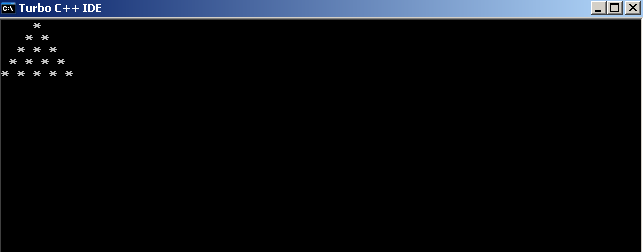
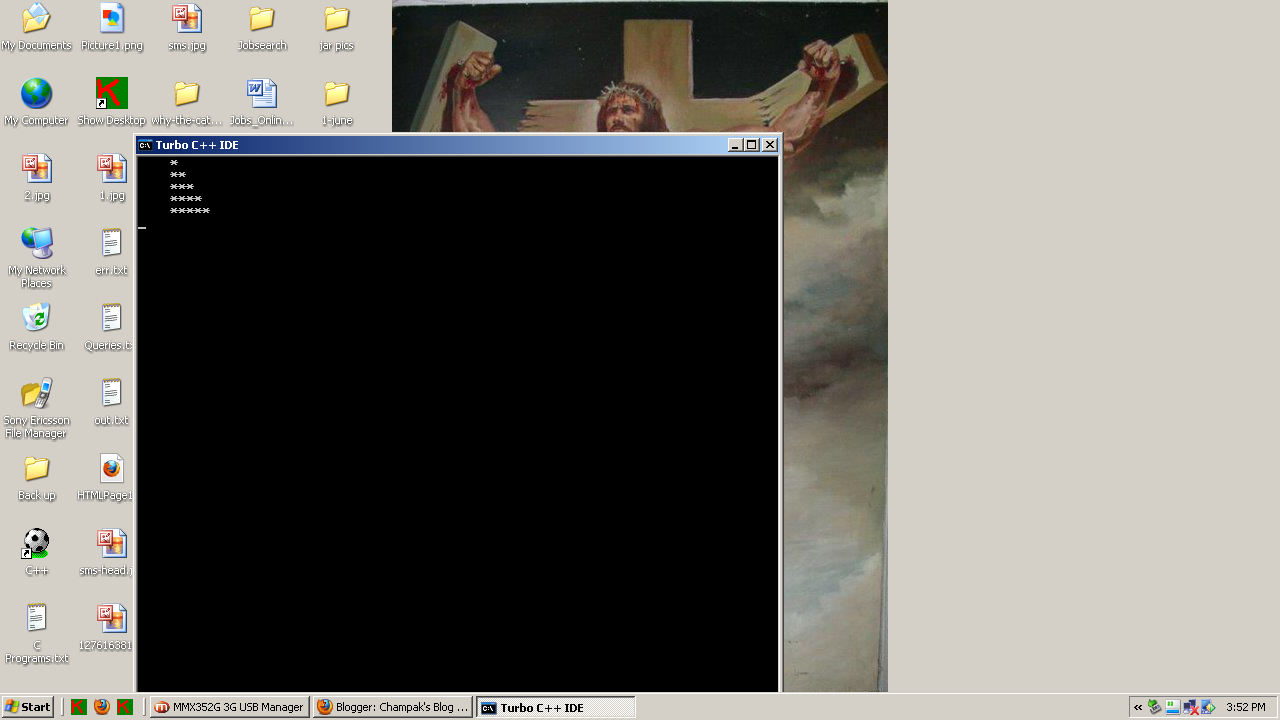
Drawing Pyramids

Drawing Pyramids

#include<stdio.h>

#include<conio.h>

void main()

{

int n=5,i,j,k;

clrscr();

for(i=1;i<=n;i++)

{

for(j=1;j<=n-1;j++)

printf(" ");

for(k=1;k<=i;k++)

printf("*");

printf("\n");

}

getch();

}

#include<stdio.h>
#include<conio.h>
void main()
{
int n=5,i,j,k;
clrscr();
for(i=1;i<=n;i++)
{
for(j=1;j<=0;j++)
printf(" ");
for(k=1;k<=i;k++)
printf("*");
printf("\n");
}
getch();
}


#include<stdio.h>
#include<conio.h>
void main()
{
int n=5,i,j,k;
clrscr();
for(i=1;i<=n;i++)
{
for(j=1;j<=n-i;j++)
printf(" ");
for(k=1;k<=2*i-1;k++)
printf("*");
printf("\n");
}
getch();
}

#include<stdio.h>
#include<conio.h>
#include<math.h>
void main()
{
int n=5,i,j,k;
int x,y;
clrscr();
for(i=1;i<=n;i++)
{
for(j=1;j<=n-i;j++)
printf(" ");
for(k=1;k<=2*i-1;k++)
{
x=i-abs(i-k);
printf("%d",x);
}
printf("\n");
}
getch();
}


#include<stdio.h>
#include<conio.h>
#include<math.h>
void main()
{
int n=5,i,j,k;
int x,y;
clrscr();
for(i=1;i<=n;i++)
{
for(j=1;j<=n-i;j++)
printf(" ");
for(k=1;k<=2*i-1;k++)
{
x=i-abs(i-k);
printf("%c",'A' + x -1);
}
printf("\n");
}
getch();
}


#include<stdio.h>
#include<conio.h>
#include<math.h>
void main()
{
int n=5,i,j,k;
int x,y;
clrscr();
for(i=n;i>=1;i--)
{
for(j=1;j<=n-i;j++)
printf(" ");
for(k=1;k<=2*i-1;k++)
{
x=i-abs(i-k);
printf("%c",'A' + x -1);
}
printf("\n");
}
getch();
}


#include<stdio.h>
#include<conio.h>
#include<math.h>
void main()
{
int n=5,i,j,k;
clrscr();
for(i=1;i<=n;i++)
{
for(j=1;j<=n-i;j++)
printf(" ");
for(k=1;k<=i;k++)
{
printf("* ");
}
printf("\n");
}
getch();
}


#include<stdio.h>
#include<conio.h>
#include<math.h>
int pascalvalue(int y,int x);
void main()
{
int n=5,i,j,k;
clrscr();
for(i=1;i<=n;i++)
{
for(j=1;j<=n-i;j++)
printf(" ");
for(k=1;k<=i;k++)
{
printf("%d ",pascalvalue(i,k));
}
printf("\n");
}
getch();
}

int pascalvalue(int y,int x)
{
if(x==1)
return(1);
if(x==y)
return(1);
return(pascalvalue(y-1,x-1) + pascalvalue(y-1,x));
}
#include<stdio.h>
#include<conio.h>
#include<math.h>

void main()
{
int n=5,i,j,k;
int mid=(n+1)/2,x,y;
clrscr();
for(i=1;i<=n;i++)
{
x=abs(mid-i);
y=mid-x;
for(j=1;j<=y;j++)
printf(" ");
for(k=1;k<=2*x+1;k++)
printf("*");
printf("\n");
}
getch();
}


#include<stdio.h>
#include<conio.h>
#include<math.h>

void main()
{
int n=5,i,j,k;
int mid=(n+1)/2,x,y,z;
clrscr();
for(i=1;i<=n;i++)
{
x=abs(mid-i);
y=mid-x;
for(j=1;j<=y;j++)
printf(" ");
for(k=1;k<=2*x+1;k++)
{
z=x-abs(x+1-k)+1;
printf("%d",z);
}
printf("\n");
}
getch();
}


#include<stdio.h>
#include<conio.h>
#include<math.h>

void main()
{
int n=5,i,j,k;
int mid=(n+1)/2,x,y,z;
clrscr();
for(i=1;i<=n;i++)
{
x=abs(mid-i);
y=mid-x;
for(j=1;j<=y;j++)
printf(" ");
for(k=1;k<=2*x+1;k++)
{
z=x-abs(x+1-k);
printf("%c",'A' + z);
}
printf("\n");
}
getch();
}

#include<stdio.h>
#include<conio.h>
#include<math.h>

void main()
{
int n=5,i,j,k;
int mid=(n+1)/2,x,y,l,r;
clrscr();
for(i=1;i<=n;i++)
{
x=abs(mid-i)+1;
y=mid-x;
for(j=1;j<=n;j++)
{
l=j;
r=n+1-j;
if(j<=x || r<=x)
printf("*");
else
printf(" ");
}
printf("\n");
}
getch();
}
#include<stdio.h>
#include<conio.h>
#include<math.h>

void main()
{
int n=11,i,j,k;
int mid=(n+1)/2,x,y,l,r,z;
clrscr();
for(i=1;i<=n;i++)
{
x=abs(mid-i)+1;
y=mid-x;
for(j=1;j<=n;j++)
{
l=j;
r=n+1-j;
z=abs(mid-j);
if(j<=x || r<=x)
printf("%d",z);
else
printf(" ");
}
printf("\n");
}
getch();
}
#include<stdio.h>
#include<conio.h>
#include<math.h>

void main()
{
int n=11,i,j,k;
int mid=(n+1)/2,x,y,l,r,z;
clrscr();
for(i=1;i<=n;i++)
{
x=abs(mid-i)+1;
y=mid-x;
for(j=1;j<=n;j++)
{
l=j;
r=n+1-j;
z=mid-abs(mid-j)-1;
if(j<=x || r<=x)
printf("%c",'A' + z);
else
printf(" ");
}
printf("\n");
}
getch();
}

#include<stdio.h>
#include<conio.h>
#include<math.h>
#define n 4
void main()
{

int l=0,r=n-1,t=0,b=n-1,i,x=1,j;
int a[n][n];
clrscr();
while(x<=n*n)
{
for(i=l;i<=r;i++)
a[t][i]=x++;
t++;
for(i=t;i<=b;i++)
a[i][r]=x++;
r--;
for(i=r;i>=l;i--)
a[b][i]=x++;
b--;
for(i=b;i>=t;i--)
a[i][l]=x++;
l++;
}
for(i=0;i<=n-1;i++)
{
for(j=0;j<=n-1;j++)
printf("%4d",a[i][j]);
printf("\n");
}
getch();
}

#include<stdio.h>
#include<conio.h>
#include<math.h>
#define n 4
void main()
{

int l=0,r=n-1,t=0,b=n-1,i,x=1,j;
int a[n][n];
clrscr();
while(x<=n*n)
{
for(i=l;i<=r;i++)
a[t][i]=x++;
t++;
for(i=t;i<=b;i++)
a[i][r]=x++;
r--;
for(i=r;i>=l;i--)
a[b][i]=x++;
b--;
for(i=b;i>=t;i--)
a[i][l]=x++;
l++;
}
for(i=0;i<=n-1;i++)
{
for(j=0;j<=n-1;j++)
printf("%4d",n*n + 1-a[i][j]);
printf("\n");
}
getch();
}

Monday, May 28, 2012

Pointers in C

Pointers in C
A pointer is the address of a variable.For understanding pointers let us consider the following declarations:-

There are only two operators in C regarding pointers.
& is the addressing operator, and when applied to a variable gives it's address.

* is the value or indirection operator. When applied to an address it gives the value at the address. 

1) 
int x=10;
int *p=&x;
int **q=&p;

x is a variable of type int. It's value is 10. Let us assume it's address is 1000.

int *p; *p is an int, p is the address of an int.The value of p is &x i,e address of x which is 1000.

int **q; **q is an int, *q is a pointer to int, q is a pointer to pointer to int.


x is thus equivalent to *p and both are 10.
&x is equivalent to p and is 1000


What is &*p?
replace *p by x, we get &x which is p .
Therefore we can say that &* cancel out.

The same is true for *&x.


Consider this program :-
*******************************ptr.c**************************
#include<stdio.h>
#include<conio.h>
void main()
{
int x=10;
int *p=&x;
clrscr();
printf("%u,%d\n",&x,x);
printf("%u,%d\n",p,*p);
getch();
}


The output:-


64948,10
64948,10

The equivalence of Arrays & Pointers.

The following program should be self explanatory:-


#include<stdio.h>
#include<conio.h>
void main()
{
int a[]={1,2,3,4,5},n=5,i;
int *p=a;
clrscr();
for(i=0;i<=n-1;i++)
printf("%d,",*(p+i));
printf("\n");
for(p=a;p<=&a[n-1];p++)
printf("%d,",*p);
printf("\n");
for(p=a;p<=&a[n-1];)
printf("%d,",*p++);
printf("\n");
//This reads the array using array syntax
for(i=0;i<=n-1;i++)
scanf("%d",&a[i]);
for(p=a;p<=&a[n-1];)
printf("%d,",*p++);
printf("\n");
//Since &a[i] translates to p+i, therefore we have
for(p=a;p<=&a[n-1];)
scanf("%d",p++);
printf("\n");

for(p=a;p<=&a[n-1];)
printf("%d,",*p++);
printf("\n");
getch();
}
The output:-


Parameter passing using pointers

#include<stdio.h>
#include<conio.h>
void valueswap (int a,int b);
void ptrswap(int* a,int* b);
void main()
{
int x=5,y=10;
clrscr();
printf("Value before value swap a = %d, b = %d\n",x,y);
valueswap(x,y);
printf("Value after value swap a = %d, b = %d\n",x,y);
printf("Value before ptr swap a = %d, b = %d\n",x,y);
ptrswap(&x,&y);
printf("Value after ptr swap a = %d, b = %d\n",x,y);
getch();
}
void valueswap (int a,int b)
{
int t=a;
a=b;
b=t;
}
void ptrswap(int* a,int* b)
{
int t=*a;
*a=*b;
*b=t;
}


The output:-

To understand this assume the following.

Variable    |    Value    |    Address
x                    5               1000
y                    10             1002


for valueswap

void valueswap (int a,int b)
{
int t=a;
a=b;
b=t;
}


after parameter copy
a=5
b=10

int t=a; t = 5
a=b; a=10;
b=t; b=5

The values of x and y are not changed. Therefore the output in main remains unaffected .


For ptrswap


void ptrswap(int* a,int* b)
{
int t=*a;
*a=*b;
*b=t;
}


It is called as ptrswap(&x,&y);=ptrswap(1000,1002);
Therefore after  parameter passing a=1000, and b=1002


int t=*a which translates as t=*1000 which means value at address 1000 which is the value of x ans is 5.
so t=5;


*a=*b, which translates as *1000 = * 1002. Replace value at address 1000 with value at address 1002.
This means that x becomes 10.


*b=t; which translates as *1002=5. Therefore value at address 1002, i,e y becomes 5.


Therefore , x and y are swapped.


Saturday, May 19, 2012

Implementing 1's Complement & 2's Complement in C

Implementing 1's Complement & 2's Complement in C
1's complement and 2's complement arithmetic is used in Computer Science for implementing the basic operations of addition and subtraction. In this program , I have endeavored to provide a simple menu based example in C of these basic operations. 

To implement these operations I have developed the following functions:-

void printMenu()
{
clrscr();
gotoxy(5,5);
printf("Read\tPrint\t1'sComplement\t2'sComplement\tAdd\tSub\teXit\n");
printf("A = ");
printNumber(a);
printf("  B = ");
printNumber(b);
printf("  C = ");
printNumber(c);
printf("\n");
}
This is the Menu. It works by pressing R,P,1,2,A,S,X
The menu is not case sensitive.

void copyArray(int dest[],int src[])
{
 int i;
 for(i=0;i<=8;i++)
 dest[i]=src[i];
}
copies the src array into dest.


int getCarry(int a,int b,int c)
{
int sum=a+b+c;
switch(sum)
{
 case 0:return(0);
 case 1:return(0);
 case 2:return (1);
 default:return(1);
}
}
adds 3 bits and returns the carry.


int getSum(int a,int b,int c)
{
int sum=a+b+c;
switch(sum)
{
 case 0:return(0);
 case 1:return(1);
 case 2:return (0);
 default:return(1);
}
}
Adds three bits and returns the sum


void TwosComplement(int x[])
{
int temp[]={1,0,0,0,0,0,0,0,0};
int out[9];
copyArray(out,x);
OnesComplement(out);
addNumber(out,temp,x);
}
finds the 2's complement of a number and stores it in the same array.


void OnesComplement(int x[])
{
int i;
for(i=8;i>=0;i--)
x[i]=1-x[i];
}
finds the 1's complement of a number.

void printNumber(int x[])
{
int i;
for(i=8;i>=0;i--)
printf("%d",x[i]);
}
prints the number

void readNumber(int x[])
{
int i;
char str[10];
scanf("%s",str);
for(i=8;i>=0;i--)
x[i]=(str[8-i]-'0'); //0,1,2,3,4 '0'-'0'=0,'1'-'0'=1
 }

reads a number as a string of 9 characters and stores it in a int array.

void subNumber(int x[],int y[],int sub[])
{
int temp[9];
copyArray(temp,y);
TwosComplement(temp);
addNumber(x,temp,sub);
}
subtracts 2 numbers and stores it in the 3rd parameter

Important

Each array is 9 elements, 8 for the byte and the ninth for the sine bit.
Therefore values must be entered as such

Here are some snapshots:-


The Complete Program

Binary.c

#include<stdio.h>                                                  
#include<conio.h>
#include<math.h>
int a[9]={0,0,0,0,0,0,0,0,0},b[9]={0,0,0,0,0,0,0,0,0},c[9]={0,0,0,0,0,0,0,0,0};
void readNumber(int x[]);
void printNumber(int x[]);
void OnesComplement(int x[]);
void addNumber(int x[],int y[],int sum[]);
void TwosComplement(int x[]);
int getSum(int a,int b,int c);
int getCarry(int a,int b,int c);
void copyArray(int dest[],int src[]);
void subNumber(int x[],int y[],int sub[]);
void printMenu();
void main()
{

int option,ch;
clrscr();
while(1)
{
printMenu();
option=getch();
switch(option)
{
case'X':
case'x':
return;
case 'r':
case 'R':
printf("\nEnter a or b: ");
ch=getche();
printf(" = ");
if(ch=='a' || ch=='A')
readNumber(a);
else
readNumber(b);
break;
case '1':
printf("\nEnter a or b: ");
ch=getche();
printf(" = )");
if(ch=='a' || ch=='A')
OnesComplement(a);
else
OnesComplement(b);
break;

case '2':
printf("\nEnter a or b: ");
ch=getche();
printf(" = ");
if(ch=='a' || ch=='A')
TwosComplement(a);
else
TwosComplement(b);
break;
case 'a':
case 'A':
addNumber(a,b,c);
break;
case 's':
case 'S':
subNumber(a,b,c);
break;
}
}
}
void printMenu()
{
clrscr();
gotoxy(5,5);
printf("Read\tPrint\t1'sComplement\t2'sComplement\tAdd\tSub\teXit\n");
printf("A = ");
printNumber(a);
printf("  B = ");
printNumber(b);
printf("  C = ");
printNumber(c);
printf("\n");
}
void copyArray(int dest[],int src[])
{
 int i;
 for(i=0;i<=8;i++)
 dest[i]=src[i];
}
void addNumber(int x[],int y[],int sum[])
{
 int i,s,carry=0;
 for(i=0;i<=8;i++)
{
   s=getSum(x[i] ,y[i],carry);
   carry=getCarry(x[i],y[i],carry);
   sum[i]=s;
}
}
int getCarry(int a,int b,int c)
{
int sum=a+b+c;
switch(sum)
{
 case 0:return(0);
 case 1:return(0);
 case 2:return (1);
 default:return(1);
}
}
int getSum(int a,int b,int c)
{
int sum=a+b+c;
switch(sum)
{
 case 0:return(0);
 case 1:return(1);
 case 2:return (0);
 default:return(1);
}
}
void TwosComplement(int x[])
{
int temp[]={1,0,0,0,0,0,0,0,0};
int out[9];
copyArray(out,x);
OnesComplement(out);
addNumber(out,temp,x);
}
void OnesComplement(int x[])
{
int i;
for(i=8;i>=0;i--)
x[i]=1-x[i];
}
void printNumber(int x[])
{
int i;
for(i=8;i>=0;i--)
printf("%d",x[i]);
}

void readNumber(int x[])
{
int i;
char str[10];
scanf("%s",str);
for(i=8;i>=0;i--)
x[i]=(str[8-i]-'0'); //0,1,2,3,4 '0'-'0'=0,'1'-'0'=1
 }
void subNumber(int x[],int y[],int sub[])
{
int temp[9];
copyArray(temp,y);
TwosComplement(temp);
addNumber(x,temp,sub);
}
Next, we shall use it to implement the Booth's algorithm